


How Stardew Valley’s Core Gameplay Loop Enables Game Progression and Influences Player Motivation
- Mikolaj Brzuchalski
- Oct 9, 2023
- 7 min read

An essay analysing and exploring how Stardew's core daily gameplay loop fosters progression and influences player's motivation to perform repetitive tasks and continue playing.
#StardewValley #GameDesign #Gameplay #GameplayLoop #PlayerMotivation #GameProgression #Analysis #Essay #Games #PlayerPsychology
Introduction
Stardew Valley is a charming pixel-art farming simulator in which players are expected to manage their own plot of land and engage with the community through interactions with a wide array of personalities within the in-game town. At its core, the gameplay is reminiscent of games from the Harvest Moon series. However, the solo-developer, Eric Barone, expanded on the mechanics of earlier farming games to fully utilise the player’s ability to feel autonomous in the game’s semi-open world that lends itself to early game exploration. This analysis will highlight the core gameplay loop within Stardew Valley, how it enables game progression and its influence on the player’s motivation.
Farming Structure
Similarly to comparable farming simulators on the market, Stardew Valley establishes a core gameplay loop that revolves around the production and collection of raw produce, adding value where possible and exchanging it for profit. This is then typically re-invested into the farm or equipment so that the farm can be run more efficiently or the player can grow more lucrative crops, both leading to higher profit margins for the player.

It can be argued that this core gameplay loop lends itself to progression and early-game player motivation, as players can easily and immediately recognise their progress through improved cash-flow and a more positive financial standpoint. Furthermore, this can also be recognised by the player through the visual growth of the farm from the cluttered starting plot of land to a large well-managed farm, or by the purchase of higher value equipment or machinery which previously was unattainable, but through continued re-investment into the farm the player can now afford to purchase.
Stardew Valley Structure
Where Stardew Valley improves on this typical farming gameplay is by introducing multiple opportunities and ways in which the player can generate resources which all feed back into the core gameplay model.
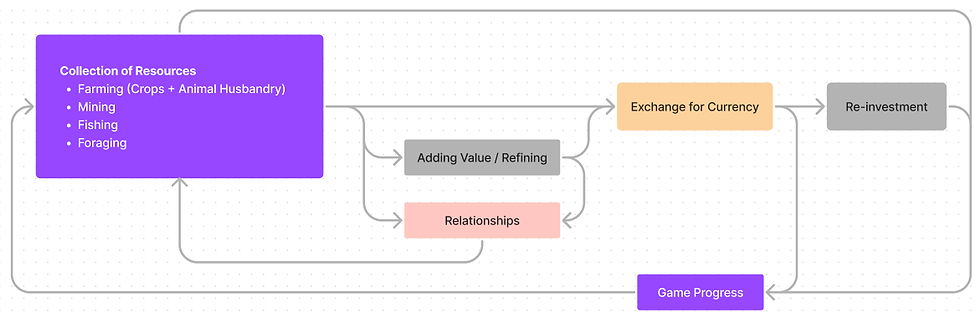
Resources in Stardew Valley can be collected through participation in four different main activities: farming (grouping together growing and harvesting crops and taking care of animals), mining, fishing, and foraging. The previous model can be broken down further to show these sub-activities. To note, for the sake of simplicity, the relationship mechanic has been omitted as although it is an important feature of the game overall and a source of progression, it is not going to be a focus in this analysis.

As the player only has a limited amount of time and energy permitted to perform all activities during a single in-game day, this proposes an interesting strategic decision. The player has the authority and freedom to schedule their own in-game time according to their personal strategies, or their decision and plan for the day can be dictated by their gameplay preferences or the maximum amount of effort they are willing to exert during their play session. Engaging in strictly farming activities can be mundane and repetitive, sometimes requiring thoughtful planning, but the act is highly profitable due to the volume of resources and henceforth value that can be amassed. In comparison, mining is more active and risky as the player will need to fend off various aggressive monsters inside the caves that can deal damage to the player and engage in the game’s combat system, but the resources gathered inside the mines can be sold or used for new buildings or tool upgrades. Moreover, this is where the game progression in Stardew Valley shines. As the in-game time is always ticking down in the game’s day-and-night cycle mechanic, which forces the player to retire back to their bed upon nightfall, having better tools, equipment and character stat bonuses means that tasks can be completed more efficiently and this inherently leads to the player receiving more time during the day for activities that can increase profits, resource gathering or for general strategic planning. Take farming for example, where players must use the hoe tool to till the ground first before planting a seed. This seed then must be watered using a watering can. Early game hoe and watering can tools are the least efficient, each only being able to till and water one tile and one seed. However, having late-game gold and resources means that the player can craft high-end tools. An iridium hoe for example tills 18 tiles at a single time, while the equivalent watering can is also able to match that efficiency. This improvement in efficiency means that the player can exponentially increase the amount of crops that can be grown in a day’s work, leading to higher profit margins at the end of harvests, or additional time for running other errands in the game.

It is important to note that Stardew Valley does not hold the player’s hand and it doesn’t force the player down a particular path. Instead, Stardew Valley nudges, or encourages, the player to participate in these activities by promising the player new crafting recipes, relationship points or completionist awards and achievements.

Effects on Player Motivation
According to the Self-Determination Theory, players need to feel free and autonomous, and the intrinsic motivation comes from the experience of volition and free choice in decision making and player actions. From the get-go, Stardew Valley has no explicit objectives throughout the game, and it lacks hand-holding mechanics apart from the emotional narrative exposition of the game’s main plot at the very start. Each in-game day begins with the player planning the activities that they want to engage with. As all outlined and discussed activities contribute new resources that can be re-invested back into the farm, the player can feel the game’s progression no matter what activity they are pursuing. As a result, Stardew Valley manages to engage the player through its ability to supply core psychological needs of feeling autonomous and competent. The game serves as a basis for escapism for players that are seeking these emotions that they may lack during their ever-stressful everyday life. Stardew Valley is a game that they can engage with to escape, bringing back control into their hands and allowing the player to decide the pace at which they are willing to play the game and how much effort they are willing to put into it without any penalties to the core gameplay.
Conclusion
To conclude, the systems at play in Stardew Valley are strongly based on classic core gameplay loops that are to be expected in farming simulators. However, the game offers plenty of activities that are well designed to empower the player with a strong sense of autonomy, facilitating those with a strong sense of intrinsic motivation to engage with the game’s wide and colourful world.
Summary
Stardew Valley’s core gameplay loop is based on a well-established farming game structure consisting of collecting resources, adding value through some type of extra processing, exchanging those resources for currency, and reinvesting back into the farm.
Reinvesting back into the farm is a form of game progression that is noticeable by the player due to potential improvements in efficiency allowing for more time in a day and the possibility for harvesting more lucrative crops, both leading to higher revenues and more positive cash-flow upon harvests.
Stardew Valley breaks up the collection of resources into multiple smaller, unique and more manageable gameplay loops that all feedback into the core concept of the game. The player has the freedom to plan and strategies how they will spend their limited in-game time, providing the player with a strong sense of autonomy, utilising intrinsic motivation, and fulfilling a psychological need of being in control and having a responsibility for one’s actions.
Additional Comments
I enjoy Stardew Valley because it promotes game progression in various different avenues, meaning that the player can feel like they are progressing no matter what activity they perform, and as explored in the analysis, it leads to a great amount of freedom and control over gameplay sessions.
Despite the game being a hit and receiving positive reviews and a large following, there are however some issues that exist within.
Problem and Proposed Solution 1
Although player progression is actively taking place, it may be hard by the player to recognise and judge their own skill level and be aware of how well they are running their farm as there is a lack of a direct comparison method or a more frequent review of player’s progress, making it difficult to judge individual level of mastery. Additionally, the game does not actively seek to push the player into a state where players can feel challenged and as a result, they may wrongly assume that they did in fact achieve mastery, or they may feel discouraged to play the game due to a lack of challenge.
One solution to both problems could be an introduction of a non-player adjacent farm that grows at a similar rate throughout the entire length of the playthrough and players can use it to self-assess the level of their own farm progression against it. The farm could also act as a method for the player to acquire clues on how the player should plan their farm and what they should be doing.
Another option could be utilising the game’s vast and passionate player base, allowing for an option to activate daily or weekly leaderboards to add a competitive element into the gameplay for more experienced players looking for a challenge.
Understandably, introducing such a method into the game could result in the player base focusing more on the extrinsic rewards and a more competitive gameplay than one based on intrinsic motivation, passive progression, personal expression, and exploration. However, an option to introduce this into the gameplay can attract those that were previously uninterested or became uninterested through the previous monotonous play sessions, widening the potential to appeal to a wider market of gamers. Additionally, the game could encourage those that previously completed the game to make a comeback and try their hand at a more competitive scenario.
Problem and Proposed Solution 2
Another issue evident in the game is more technical, but it does influence the progression within the game. Stardew Valley only saves at the end of each day, which means that if gameplay comes to an abrupt stop, for example from the player choosing to exit the game or it crashing, progress that was made on that given in-game day is unfortunately lost. This can be a source of unnecessary frustration. A solution to this could be an introduction of a save and load system within the in-game menu which could allow for saving of the game state during a day. This may even encourage exploration of the game systems as players would be more likely to take risks and experiment if they knew that they could reload to a previous point in the game. However, this could have other ramifications on the game which may be why Eric Barone did not include this feature. For example, players could actively save and reload in the game’s cave system to acquire better loot or avoid losing all health, disrupting the system in an unfair and advantageous way. Perhaps, saving and loading could be disabled when inside the caves to maintain its risk and reward factor.


Comments